
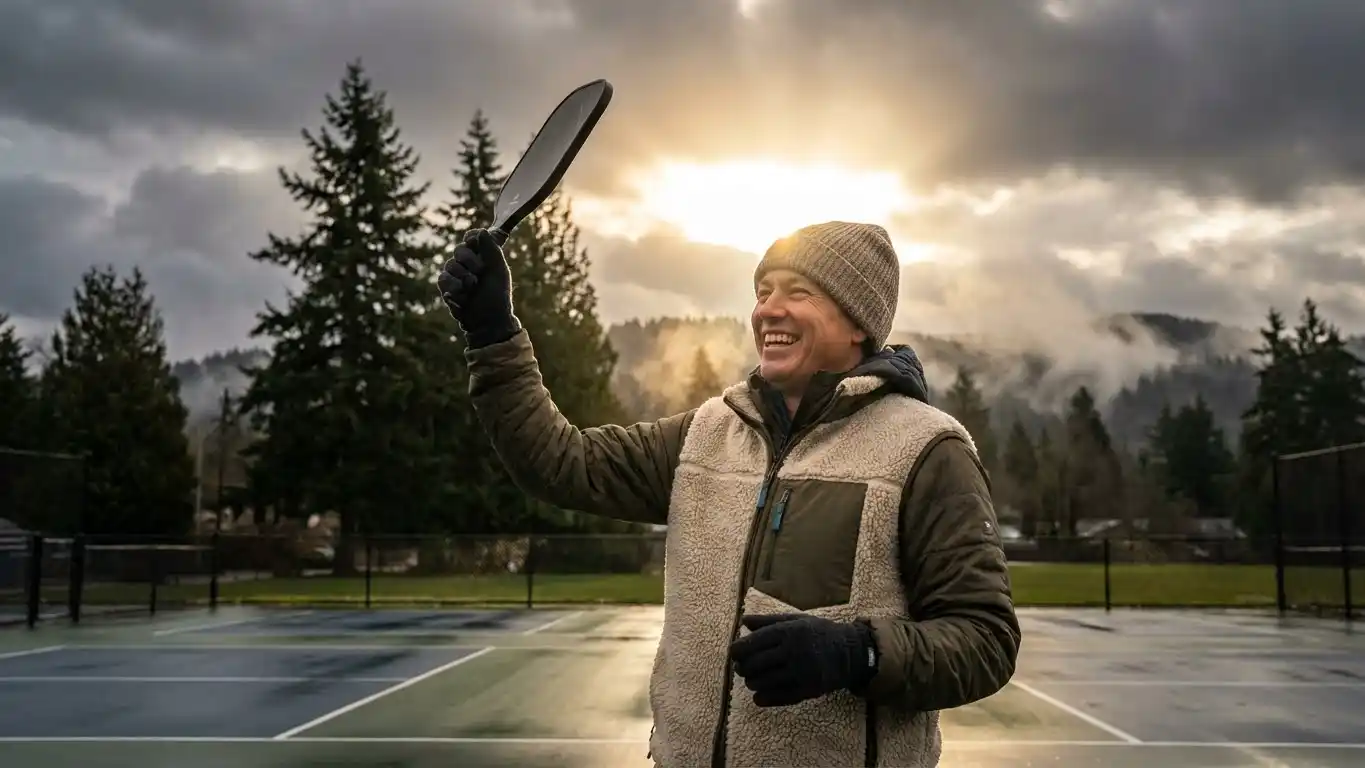
Sunbreak Dinks: Seattle’s Brightest Winter Courts
In the depths of November, dodging clouds and fir-tree shadows becomes as important as nailing your third shot drop, we map the courts where you can actually feel the sun on your paddle.
With the days growing shorter and the “Big Dark” settling over the Pacific Northwest, Seattle pickleball players face a unique adversary: the gloom. It’s not just about keeping the ball in play; it’s about keeping your spirits up. We all know the drill, checking three different weather apps, looking for that elusive hole in the clouds, and sprinting to the car the moment a beam of light hits the pavement. This guide isn’t just about court surfaces; it’s a strategic manifesto for the Vitamin D chase. We are going to break down the science of the “sunbreak,” analyze the geography of our local courts, and help you squeeze every ounce of solar energy out of your winter game.
Key Takeaways
- Winter sun angles make North-South court orientation critical to avoid blinding glare.
- Seek “Sunbreak Windows” by tracking cloud movement and finding western exposures.
- High-elevation courts like Jefferson Park often rise above the low-hanging fog valleys.
- Tree lines on the southern/western edges of courts are the primary enemy of winter light.
- Pair your play with “Dine” spots that offer warm, covered seating for post-match recovery.
- Alki and Golden Gardens offer western exposure, perfect for catching the coveted “Golden Hour.”
The Seasonal Affective Struggle: Why We Chase the Light
Let’s be real for a second. Living in Seattle means we have a complicated relationship with the sun. During the summer, it’s a non-stop party of late sunsets and glorious ladder leagues that go until 9:30 PM. But come November? The script flips. The shadows lengthen, the fir trees seem to grow taller, and the sun hangs low in the sky like a lazy lob waiting to be smashed.
For the dedicated pickleball fanatic, this seasonal shift necessitates a change in strategy. You can no longer just show up at your local park and expect prime conditions. You have to hunt for them. The obsession with catching “sun breaks” is real, and it directly impacts how we enjoy the sport. When you’re standing at the baseline, shivering in a fleece vest, that sudden warmth of direct sunlight hitting your face is better than executing a perfect ATP (around the post). It’s life-giving.
Does court location really matter that much in winter?
Absolutely. A court nestled in a bowl or surrounded by evergreens might stay damp and dark all day, even when the sun is shining just a mile away. Conversely, a court on a breezy plateau can offer a dry surface and a morale-boosting view.
Is it safe to play on damp courts?
Generally, no. If the court is wet, the lines become slick paint, and the risk of injury skyrockets. Sun exposure isn’t just about Vitamin D; it’s about drying the asphalt so you can safely plant your feet for that dink volley.
The Sunbreak Timing Framework
To master the art of winter pickleball in Seattle, you need to understand the rhythm of the light. The sun doesn’t just rise and set; it performs a low-to-the-horizon dance that creates distinct windows of opportunity. We call this the Sunbreak Timing Framework. By aligning your play schedule with these windows, you can maximize your chances of catching some rays.
Morning Dinks: The Eastern Awakening
The “Morning Dink” session is for the early risers who want to start their day with some energy. In the winter, the sun rises late and stays low in the southeast. This means the eastern horizon is your best friend.
What to look for:You want courts where the eastern side is relatively clear. If there’s a dense wall of tall buildings or Douglas firs directly to the east of the courts, you might be playing in the shade until 11:00 AM. Look for parks where the “morning window” is unobstructed. This allows the sun to clear the horizon and immediately hit the court surface, warming up the asphalt and melting any lingering frost.
Strategic tip:If you arrive and the courts are still icy or frosty, give them 20 minutes of direct sun. It’s amazing how quickly a dark court surface absorbs heat. Use that time to warm up your body—dynamic stretching is non-negotiable in 40-degree weather.
Midday Lunch Sets: The High Noon Hustle
For the remote workers taking a “long lunch” (we won’t tell your boss), the midday window offers the brightest light of the day. However, “bright” is relative in December. The sun is still fairly low, meaning long shadows are cast by everything—nets, fences, and nearby statues.
The Fog Factor:This is crucial. In winter, Seattle often gets temperature inversions where cold fog settles in the valleys while the hills remain clear. To win the midday game, you need to think vertically. Look for courts that are elevated. Sites that sit on plateaus or ridges tend to pop out of the low fog and grab the only bright stretch of the day. Avoid the “bowls”—parks situated in low dips where the damp air collects and lingers.
Golden Hour Games: The Sunset Chase
This is the holy grail of winter pickleball. The “Golden Hour” in November might be as early as 3:30 PM, but the quality of light is spectacular. It’s that low, amber glow that makes everyone look like a movie star and makes the yellow neon of the pickleball pop against the blue-grey sky.
The Western Exposure:To capture this, you need courts with an open western flank. You want the sun to be able to dip low without immediately disappearing behind a hill or a condo complex. However, there is a catch. If the court is too open to the west, and the courts are oriented East-West, you are going to be staring directly into a blinding star on every serve. This is where the north-south orientation becomes a savior—it keeps the sun to your side, allowing you to track the ball without burning your retinas.
The Court Selection Checklist: How to Scout Your Spot
Since navigating Seattle’s micro-climates requires a bit of detective work, we’ve laid out a checklist to help you rate your local courts. Before you commit to a drive across town, run the facility through this mental scanner.
Orientation: The North-South Rule
We touched on this, but it bears repeating: Court orientation is the single most critical factor for visibility. Ideally, pickleball courts should be oriented with the baselines running North-South.
Why does this matter?If a court runs East-West, one player is staring directly into the sun in the morning, and the other is blinded in the evening. In the summer, the sun is high enough that this is a minor annoyance. In the winter, the sun is right in your line of sight. When scouting a new location, pull up a map. If those baselines point to the poles, you’re in for a much more pleasant game.
Tree Cover: The Evergreen Enemy
We love our Emerald City trees, but on the pickleball court, they are formidable opponents. Tall evergreens, specifically the towering Cedars and Firs common in our parks, cast long, dense shadows that never move.
The Shadow Clock:In November, a 50-foot tree on the south side of a court can render half the playing surface unplayable. It creates a “zebra stripe” effect of light and dark that messes with your depth perception. When evaluating a court, look at the southern and western perimeters. The further back the tree line, the better. You want a “sky buffer” between the court fence and the forest.
Elevation: escaping the Bowl
Elevation isn’t just for hikers. As mentioned in the sunbreak framework, elevation equals exposure. Higher ground usually means better drainage (less standing water) and more wind interaction, which dries courts faster.
The Trade-off:The downside of elevation is wind. A breezy plateau dries faster, but it also means your lobs might end up in the next county. However, most Seattleites would trade a little wind for dry pavement and sunshine any day.
Lighting: The After-Dark Option
Let’s face it, the sun sets at 4:20 PM in deep winter. No amount of chasing will fix that. This is where lighting technology comes in. When the sun chase fails, or work runs late, you need reliable artificial cues.
LED vs. Halogen:Old-school halogen lights take forever to warm up and cast a yellow, uneven glow. Modern LED setups are instant-on and provide a crisp, white light that mimics daylight. When checking out a facility, note the type of lights. Good LEDs can extend your pickleball season through the darkest months, allowing for evening ladder leagues that keep the community vibrant even when the sky is pitch black.
Amenities: The Comforts of Winter
Finally, don’t overlook the creature comforts. Playing in the cold requires more gear and more breaks.
- Wind Protection: Are there windscreens on the fences? These are vital for cutting the chill.
- Restrooms: Hydration is still key in winter, and cold weather makes … well, you know. Accessible, unlocked restrooms are a must.
- Water Fountains: many parks shut them off in winter to prevent freezing. Always bring your own water, but a working bottle filler is a huge bonus.
Seattle’s Sun-Chasing Hotspots: A Field Guide
Based on our framework, several neighborhoods stand out as prime candidates for the winter sun chase. While we are looking at these through the lens of our checklist, these “Big Five” hubs are where you want to focus your scouting efforts.
Green Lake: The Community Hub
Green Lake is the beating heart of Seattle’s recreational scene.
- The Vibe: It’s always buzzing. Even on gray days, you’ll find die-hards here.
- The Sunbreak Potential: The lake itself provides a massive opening in the tree canopy. While the park is ringed with trees, the open water creates a “light well.” If the courts are situated to take advantage of this break, you can get decent exposure.
- The Wind Factor: Because it’s near water, it can be breezy, but the surrounding trees often act as a buffer.
- Scouting Note: Pay attention to which side of the park the courts are on. East Green Lake gets that glorious afternoon sun across the water, while West Green Lake might fall into shadow earlier.
Bitter Lake: The North-End Refuge
Heading north, Bitter Lake Community Center is a staple for the dedicated player.
- Elevation & Exposure: Often sitting on flatter, open ground typical of the northern playfields, this spot can be a great candidate for “Midday Lunch Sets.”
- The “North-End Night Owls”: If the facility has upgraded lighting, this becomes the go-to spot for the after-work crowd who missed the sun but still need their fix.
- Amenities: Community centers usually mean reliable restrooms and water access—gold dust in the winter months.
Jefferson Park: The High Ground
Perched atop Beacon Hill, Jefferson Park is a textbook example of the “Elevation Advantage.”
- The View: On a clear day, the views of the Olympics and the city are unmatched. This isn’t just scenery; it’s evidence of the open sky.
- Fog Buster: This is the place to go when the valleys are socked in. You might drive up through the mist and pop out into brilliant sunshine.
- Tree Cover: It’s a golf course and park setting, meaning lots of open grass and fewer towering forests directly adjacent to some activity areas. This openness is perfect for maximizing those precious photon hits properly.
- The Wind Warning: Being on a ridge, it gets windy. Bring a heavier outdoor ball (like a Dura Fast 40 or the new Selkirk Pro S1) that can cut through the gusts.
Rainier Beach: The Southern Sun Trap
Down in the south end, Rainier Beach offers a different micro-climate.
- Valley Dynamics: Sometimes the south end gets sunbreaks that the north end misses entirely due to the “convergence zone” phenomena.
- Community Vibe: This is often a localized, high-energy scene.
- Sun Angles: Look for courts that aren’t tucked right up against the steep ridges that define the Rainier Valley. You want distance from the western hills to keep the sunset window open as long as possible.
Alki Beach: The Western Exposure King
If there is one place to gamble on the “Golden Hour,” it’s Alki.
- Unobstructed Horizons: Facing the Puget Sound and the Olympics, there is zero tree cover to the west. If the sun is out, Alki gets it until the very last second it drops below the mountain range.
- The “Glare” Challenge: Bring your polarized sunglasses. The reflection off the water combined with the low sun can be intense.
- Mood Boost: There is something undeniably therapeutic about hearing the waves crash while you play. It turns a grim winter Tuesday into a mini-vacation.
- Wind City: It will be windy. Embrace it. It’s part of the Alki charm. Adjust your game—more drives, fewer lobs.
The Dink & Dine Strategy: Fueling the Winter Warrior
You’ve chased the sun, you’ve played your sets, and now the temperature is dropping rapidly as dusk sets in. You need warmth, food, and a place to dissect that final tie-breaker. This is where the “Dine” side of the equation comes in. Winter pickleball isn’t complete without the post-game thaw-out.
Atmosphere is EverythingIn summer, a food truck and a curb work fine. In winter, you need walls and heat. We categorize our dining partners into three vibes:
The “Brunch-then-Dink”
This is for the weekend warriors hitting the morning window. You want a spot that opens early (8:00 AM) and serves serious coffee.
- What to look for: Hearty breakfasts. You just burned a ton of calories in the cold; a kale salad won’t cut it. You want scrambles, hash browns, and mugs of coffee the size of your head.
- Proximity: It needs to be within a 5-minute drive. You don’t want your muscles to stiffen up in the car before you get food.
The “Dink-then-Date-Night”
Did you manage to snag a court for the Golden Hour? Transition straight into a nice evening.
- The Transition: Look for bistros or gastro-pubs that are casual enough for “sporty-chic” attire but nice enough for a glass of red wine.
- The Vibe: Warm lighting, perhaps a fireplace, and a menu that leans towards comfort food—braised meats, warm pastas, and rich appetizers.
The “Family Dink & Dine”
If you’ve dragged the kids along to chase the sun, you need a landing zone that accommodates everyone.
- The Setup: Casual burger joints or pizza places are the natural fit.
- Amenities: Space for bulky winter coats and gear bags is a must. You don’t want to be the group knocking over vases with your paddle bag.
- The Reward: A hot pizza after freezing on the court is a core memory for any Seattle pickleball family.
Assessing Your Winter Wardrobe
Finding the sunniest court is only half the battle; dressing for it is the other. The “sunbreak” can raise the “feels-like” temperature by 10 degrees instantly, but the shade drops it just as fast.
The Layering System:You need a three-layer system.
- Base Layer: Moisture-wicking synthetic or merino wool. Never cotton. Sweat turns ice-cold when you stop moving.
- Insulation Layer: A fleece vest is the pickleball player’s best friend. It keeps your core warm but leaves your arms free for those overhead smashes.
- Shell Layer: A light windbreaker that you can strip off the moment the sun hits and shove into your bag.
Eye Protection:We mentioned polarized sunglasses for Alki, but they are essential everywhere in winter. The sun angle is so low (oftentimes just 20-30 degrees above the horizon) that glare is a constant threat to your tracking ability. Amber or rose-tinted lenses can help increase contrast against the grey asphalt and green trees.
Wrapping Up: the Joy of the Chase
There is a unique camaraderie among winter pickleball players in Seattle. We nod at each other in the parking lots, acknowledging the shared effort it took just to get there. We share intel on which courts are dry and which are covered in wet leaves. We celebrate the sunbreaks like lottery wins.
By using the Court Selection Checklist and the Sunbreak Timing Framework, you stop being a victim of the weather and start being a strategic player in it. You learn to read the sky, the tree lines, and the fog banks. You find those pockets of joy—those bright, crisp hours where the air is fresh, the ball is loud, and the sun is shining on your face.
So grab your paddle, check the radar one last time, and head out. The sun is out there somewhere; you just have to know where to look.
Frequently Asked Questions (FAQs) for Sunbreak Dinks
How does cold weather affect the pickleball itself?
Cold weather hardens the plastic of the pickleball, making it bounce lower and skid faster. It also makes the ball more brittle, leading to more cracking. In temperatures below 45°F, it is highly recommended to switch to a softer outdoor ball specifically designed for cold weather to prevent cracking and maintain a consistent feel.
Why is North-South orientation so important for winter play?
In winter, the sun travels a much lower arc across the southern sky. If a court runs East-West, players will be looking directly into the sun during the morning and afternoon when the sun is near the horizon. A North-South orientation keeps the sun to the side of the court (perpendicular to play), preventing blinding glare for both players.
Can I play pickleball on a wet court if the sun is out?
It is strongly advised against playing on a wet court. Even a thin layer of moisture can make the painted lines extremely slippery, acting like ice. This significantly increases the risk of slipping, falling, and sustaining injuries like groin pulls or twisted ankles. Wait for the sun (or wind) to fully dry the surface before playing.
What is the best lens color for sunglasses during overcast Seattle days?
On overcast or mixed-lighting days, yellow, rose, or amber lenses are superior to dark grey or black lenses. These lighter tints increase contrast and depth perception, helping the yellow pickleball pop against the grey clouds and dark court surfaces, whereas dark lenses might make it too hard to see the ball in lower light conditions.
How do I prevent fogging up my glasses when playing in the cold?
To prevent glasses from fogging up in the cold, try to keep air flowing away from your lenses. Wearing a sweatband can help absorb moisture before it evaporates into your glasses. Additionally, you can use anti-fog spray or wipes on your lenses before playing. Ensuring your glasses sit slightly further down your nose can also increase airflow behind the lens.